
7 Reasons the Midwest Power Grid Is Entering a High-Risk Era
March 24, 2026
.png)
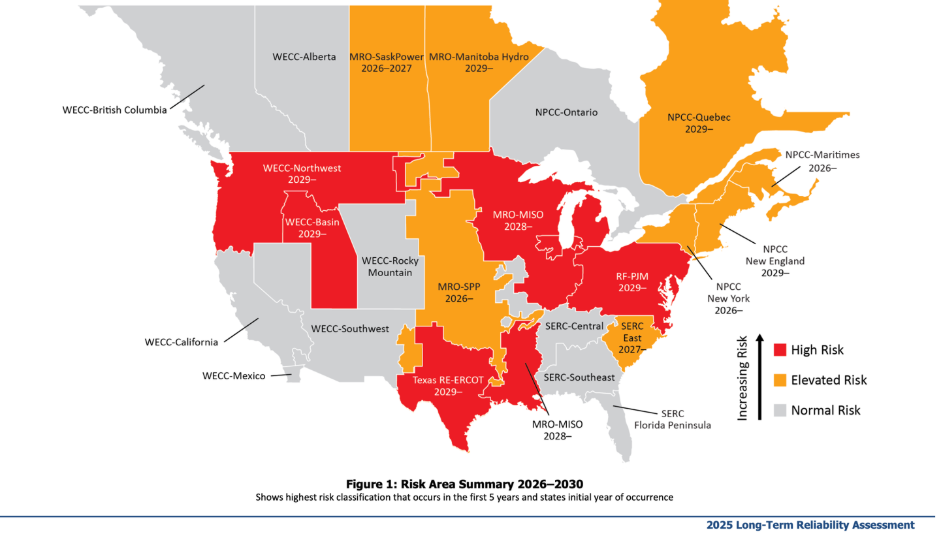
Recent assessments from the Midcontinent Independent System Operator (MISO) show reliability risks climbing steadily over the next several years.
This significant shift in a short period of time is due to the convergence of long-term structural trends that are reshaping how electricity is generated, delivered, and consumed across the Midwest. Supply is evolving, demand is accelerating, and the margin for error is shrinking.
Throughout this blog, we’ll explore 7 key reasons why the Midwest power grid is entering a high-risk era and what utilities, regulators, businesses, and communities can do about it.
Across the Midwest, older power plants are shutting down faster than the new ones are coming online.
Many coal-fired and other thermal units are reaching the end of their useful lives. Utilities are facing rising maintenance costs, stricter environmental requirements, corporate decarbonization goals, and increasing competition from lower-cost renewables. In many cases, retirement makes more economic sense.
While new wind, solar, natural gas, and battery storage projects are in development, many are still years away from operation. The gap between retirements and replacements is tightening reserve margins and shrinking the reliability cushion the grid depends on during extreme weather or demand spikes.
The Midwest has quickly become a magnet for large data centers, especially hyperscale and AI-driven facilities. It makes sense… there’s plenty of available land, electricity prices have historically been competitive, and the central U.S. location is ideal for serving customers nationwide.
So, what’s the catch? These facilities use an enormous amount of power. A single large data center campus can require hundreds of megawatts of electricity – roughly the equivalent of powering a small city. And now, multiple projects are being announced and built across the region simultaneously. This means new demand is piling onto the grid much faster than utilities originally expected.
As a result, peak demand forecasts are rising sharply, and the system has less breathing room than planned.
Beyond data centers, more parts of the Midwest economy are plugging into the grid. As the Midwest remains a national hub for advanced manufacturing, automotive production, agricultural processing, cloud, and AI infrastructure, economic growth is accelerating, leading to higher load forecasts.
Economic development incentives are attracting large industrial projects that add concentrated demand quickly — sometimes faster than utilities can plan for.
Electric vehicle manufacturing is ramping up, and charging networks are expanding. Manufacturers are reshoring operations back to the U.S., and homes and commercial buildings are shifting from gas to electric heating and upgraded electric systems.
For more than a decade, electricity demand was mostly flat. Utilities built their plans around slow, predictable growth. Now that’s changing. We’re entering a period of sustained demand growth, which is a major structural shift that requires significant investments in generation, transmission, and distribution infrastructure.
A healthy grid maintains extra generation capacity — called a reserve margin — to handle extreme heat or cold, unexpected plant outages, or transmission constraints.
MISO’s modeling shows projected reserve margin shortfalls emerging later this decade. When reserve margins shrink, the system becomes more vulnerable to stress events.
“High risk” does not mean guaranteed blackouts, but it does mean less buffer and more exposure during peak conditions.
Across the U.S., new wind, solar, storage, and natural gas projects can’t just flip a switch and connect to the grid. Before they’re allowed to come online, they must undergo a lengthy interconnection study to ensure the system can safely and reliably handle the added power.
Right now, that line is crowded. Projects are facing multi-year timelines, uncertainty about who will pay for needed grid upgrades, and ongoing supply chain delays. So even when developers are ready to build, the regulatory and transmission approval process can push projects back by several years—stretching out the timeline and widening the gap between retiring plants and new supply.
Even though MISO has approved major long-range transmission plans designed to strengthen reliability and integrate new generation, most will not be fully operational before the projected 2028-2030 high-risk window.
Large transmission lines can take 5–10 years to permit and construct. Infrastructure timelines simply lag demand growth.
The Midwest is no stranger to polar vortexes and heat waves. These events amplify risk when capacity margins are tight—especially during a generation transition.
“High risk” doesn’t mean immediate failure. It means the system has less cushion than it used to.
You’re more likely to see emergency grid alerts during peak demand. Wholesale prices may swing more dramatically. Grid operators may need to lean more heavily on demand response programs. And during extreme heat or cold, the margin for error becomes thinner.
In short, it signals a system in transition — one that’s still functioning but operating with less breathing room than before.
The Midwest power grid is entering a high-risk era as several structural forces converge at once:
Addressing this challenge comes down to better planning, coordination, and timing. Utilities and grid operators need stronger long-term forecasting and clearer commitments from large customers before locking in major infrastructure investments. Regulators must ensure new generation is fully operational before retiring older plants — and in some cases, keeping critical plants online a bit longer may be necessary to avoid reliability gaps.
Encouraging on-site generation, energy storage, and flexible load programs — particularly for large users like data centers — can reduce strain on the system. At the same time, accelerating approvals and grid interconnections for new projects will be essential to bringing replacement capacity online faster. Stronger coordination across the MISO footprint will be critical to ensuring growth does not outpace reliability during this transition.
If new resources — especially those under expedited processes — come online as planned, the region can stabilize. If not, the 2028–2030 window could become one of the most consequential reliability stress tests the Midwest has faced in decades.
The Midwest grid isn’t failing today. But the combination of rising demand, retiring generation, and infrastructure lag is compressing reliability margins. The next several years will determine whether this is a temporary squeeze — or the beginning of sustained grid vulnerability.
We realize that downtime rarely starts with a dramatic failure. It starts with an aging battery, a loose connection, or a missed maintenance cycle. Our team is offering a FREE On-Site Power Audit to surface hidden risks and leave you with a clear, practical roadmap your IT team can act on—so you can stop guessing about your next power risk and start operating with certainty.
.png)